
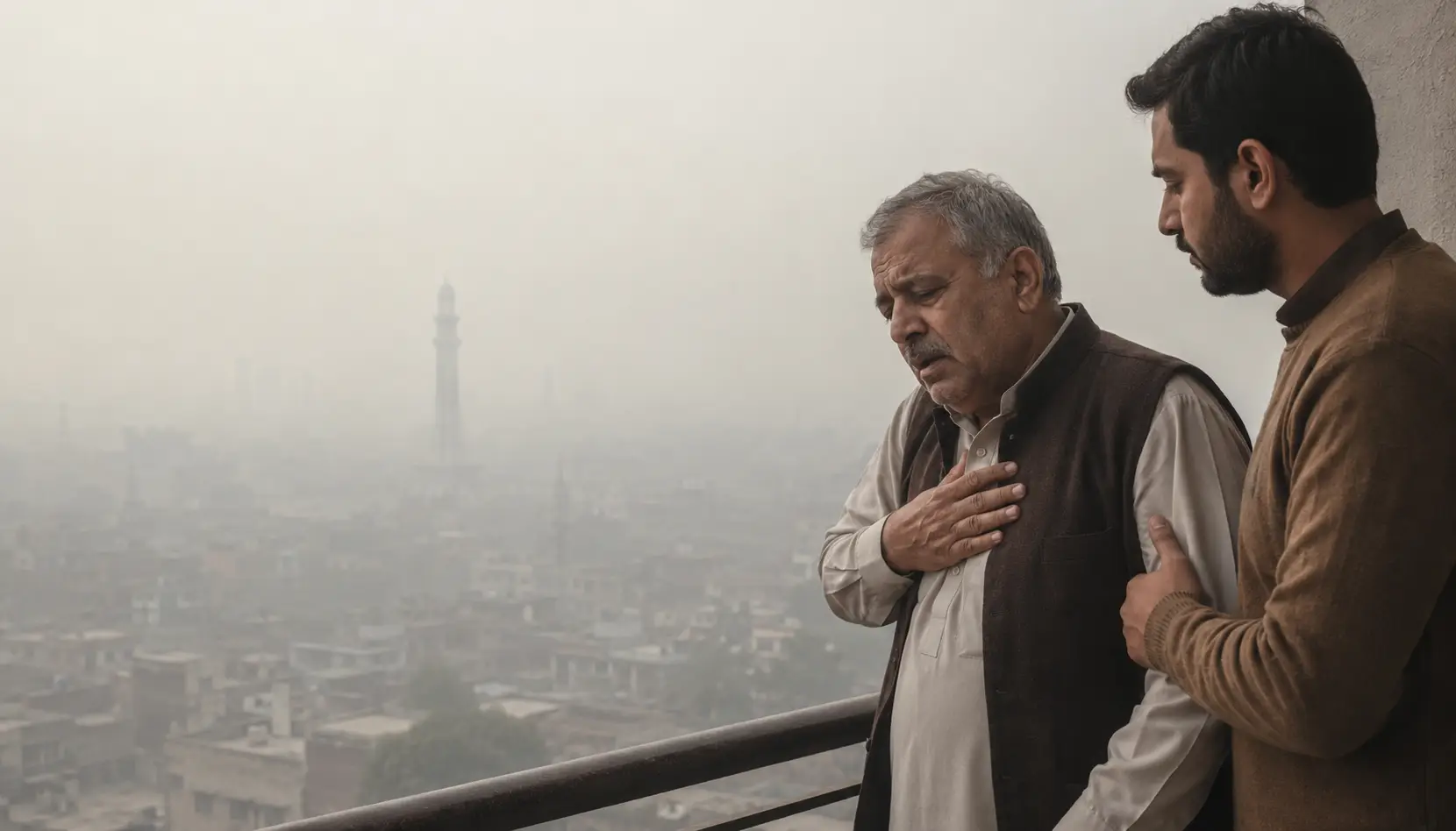
You wake up to a grey November morning in Lahore. The air outside looks thick. Your eyes sting before you even step onto the balcony. Meanwhile, your father with COPD is already coughing harder than usual, and your child with asthma says their chest feels tight. If that sounds familiar, you are not alone. Smog COPD asthma Pakistan is a growing concern for thousands of families every winter. The good news is that understanding what smog does to the lungs — and knowing what steps to take at home — can help you protect the people you care about most.
What smog actually does to your lungs (and why COPD and asthma make it worse)
Ever wondered why some people can walk through a smoggy street while others struggle to catch their breath?
Here is the thing. Smog contains tiny particles called PM2.5 particulate matter. These particles are so small that they can travel deep into the lungs. In cities like Lahore, where winter smog often blankets areas around GT Road and Ring Road, these particles enter the airways every time you breathe.
Healthy lungs have natural defenses. Tiny hairs and mucus help trap and remove pollutants before they cause damage. But COPD (chronic obstructive pulmonary disease, a long-term condition that blocks airflow) damages those defenses. Asthma causes inflamed and sensitive airways that react quickly to irritants.
Think of it this way. A healthy airway is like a clean water pipe. A COPD or asthma airway is like a pipe already narrowed by dirt and rust. Add more debris, and the flow slows dramatically. Research has consistently shown that PM2.5 exposure increases bronchospasm (sudden tightening of airway muscles), worsens breathing difficulty, and raises the risk of hospital visits during Pakistan’s smog months.
Warning signs that smog is triggering your condition?
How do you know when smog is doing more than causing minor irritation?
Watch for these signs:
- You are coughing much more than usual. Try to rest indoors and monitor symptoms closely.
- Walking across the room leaves you breathless. Stop activity immediately and use prescribed medication.
- Your chest feels unusually tight or heavy. Follow your doctor’s asthma or COPD action plan.
- You hear wheezing when breathing. Use your rescue inhaler if prescribed and contact your doctor if it continues.
- Your oxygen level drops below your normal range. Check with a pulse oximeter and seek medical advice.
- You feel unusually tired or dizzy. Sit down, hydrate, and monitor your breathing.
- Your lips or fingertips appear slightly blue. Seek urgent medical attention right away.
In Lahore, where the AQI regularly crosses dangerous levels during November and December, patients with COPD often report that even walking from one room to another leaves them gasping. You should never ignore sudden changes like these. One difficult night can become a medical emergency if warning signs are missed. According to respiratory medicine guidelines, early action often prevents more serious complications and hospital admissions.
What you can do at home during smog season in Pakistan?
Start with your indoor environment. Keep windows closed during peak smog hours, especially early mornings and evenings. Use exhaust fans carefully and avoid indoor smoke from cigarettes, incense, or burning rubbish. These simple habits reduce exposure to respiratory problems in Pakistan smog season. You should also pay attention to masks. An N95 mask filters much smaller particles than a standard surgical mask. If a COPD or asthma patient must go outdoors, an N95 mask generally provides better protection against PM2.5 pollution.
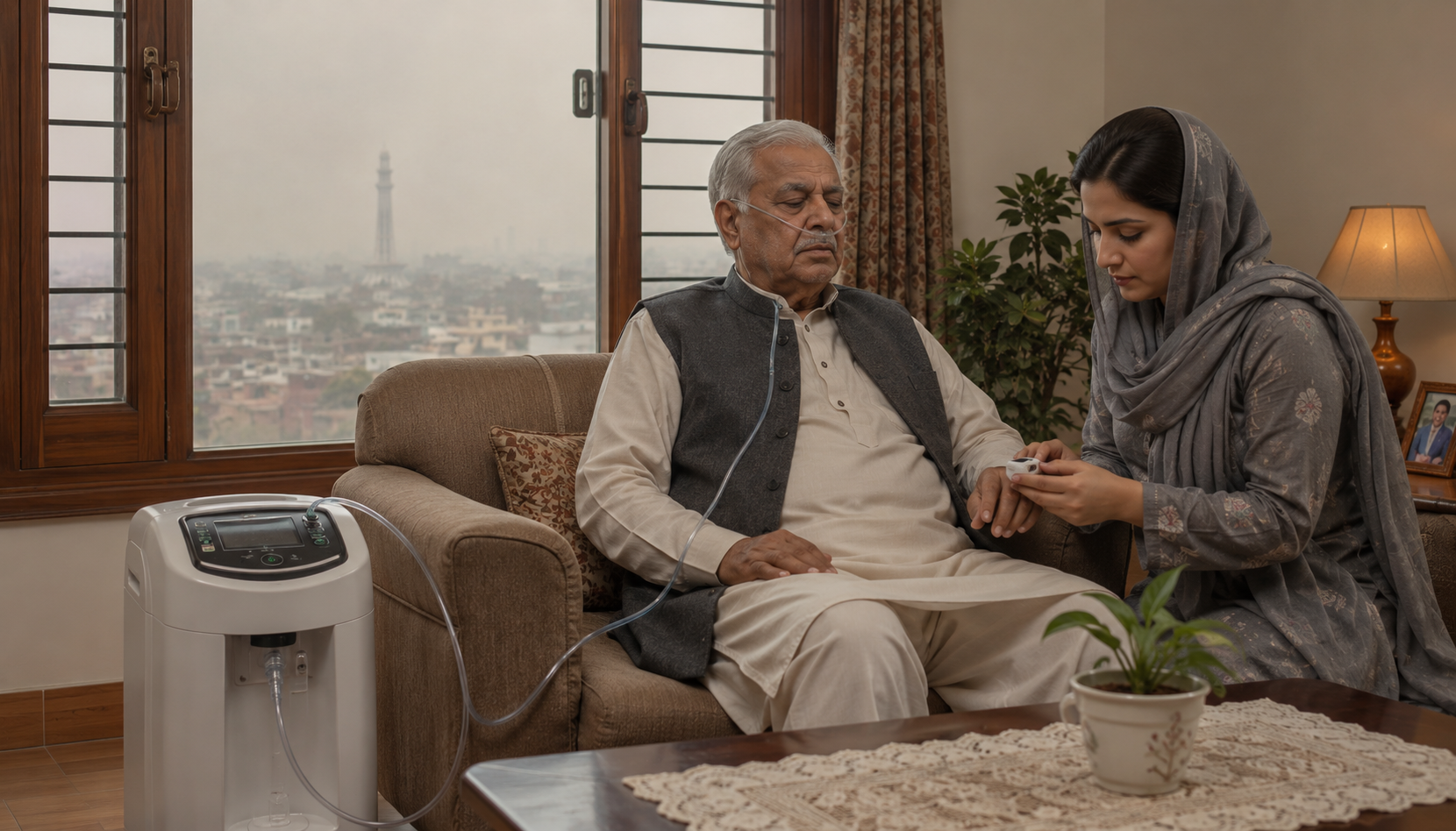
The good news is that small changes add up. Try scheduling outdoor errands during times when air quality improves. Follow local AQI updates and avoid unnecessary travel on heavily polluted days. Families in Karachi often notice that symptoms become worse during periods of stagnant air and traffic congestion, even when smog appears less visible than in Lahore. For some patients, oxygen levels begin falling during severe pollution episodes. This can lead to hypoxemia (low oxygen levels in the blood). When that happens, doctors may recommend home oxygen therapy.
An oxygen concentrator does not store oxygen like a cylinder. Instead, it pulls in room air and concentrates the oxygen before delivering it to the patient. For families searching for an oxygen concentrator for COPD at home, understanding this difference is helpful. The device provides a continuous oxygen supply without the need for frequent cylinder replacements.
When does a COPD or asthma patient need an oxygen concentrator at home?
Are you worried that needing oxygen means the illness is becoming hopeless? Let us be honest. Many families fear that recommendation. In reality, oxygen therapy is often a smart and proactive way to keep someone stable and comfortable.
Doctors usually make this decision based on oxygen saturation readings and overall symptoms. A resting oxygen saturation below approximately 88–90% is a common clinical indicator that further evaluation for oxygen therapy may be needed. Oxygen saturation measures how much oxygen is being carried by the blood. You may hear lung specialists talk about forced expiratory volume (FEV1), which measures how much air a person can forcefully exhale in one second. Lower FEV1 values often indicate more severe airflow limitation. Combined with oxygen levels, these measurements help guide treatment decisions.
In Islamabad, Karachi, and Lahore, many families first discover a problem when a pulse oximeter consistently shows low readings during winter pollution periods. Asthma worsening in winter Pakistan is also a common concern, particularly among patients already sensitive to cold air and airborne irritants. If your doctor recommends oxygen therapy, ask questions. Understand the goals, the expected duration, and the equipment options available.
How Respiratory Zone supports respiratory patients across Pakistan?
Where can families turn when they need help quickly? Respiratory Zone provides oxygen concentrators, CPAP machines, BiPAP machines, ventilators, medical beds, and monitoring equipment for patients across Pakistan. The company serves families in Lahore, Karachi, and Islamabad, with trained staff available to explain equipment setup and day-to-day use.
When urgent respiratory support is needed, Respiratory Zone offers 24/7 emergency delivery of oxygen concentrators. Families can discuss whether renting or purchasing equipment makes more sense for their situation. Ongoing support is also available to help patients use their devices safely and effectively. Help is available, even when the situation feels overwhelming.
Closing Thoughts
Smog season can be frightening when someone you love already struggles to breathe. Watching a parent, spouse, or child cough through another polluted morning is never easy. Yet families have more control than they often realize. The right habits, medical guidance, and equipment can make a meaningful difference during smog COPD asthma Pakistan season. Before purchasing or adjusting any medical device, speak with your doctor. Call Respiratory Zone on 3192004884 or visit respiratoryzone.pk — our team is available seven days a week to help you find the right solution for your family.
Disclaimer: This article is for informational purposes only. Always consult a qualified medical professional before making any decisions about your health or home medical equipment.